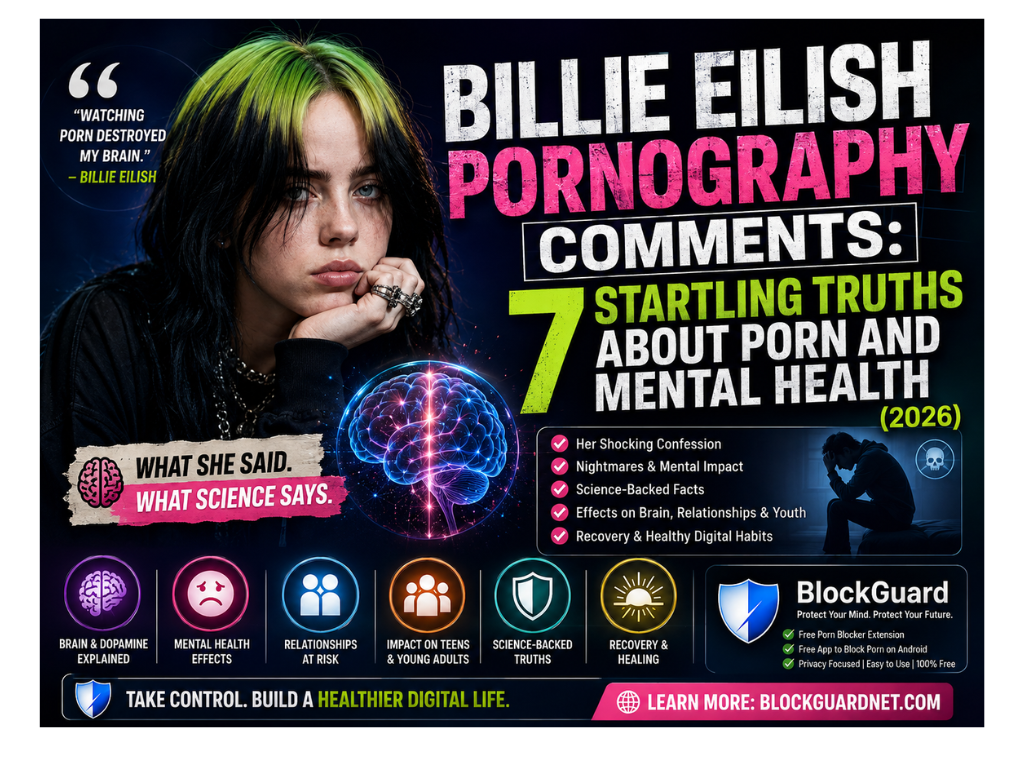
If you searched for billie eilish on porn addiction, you are probably looking for the interview that brought this topic into the public conversation. During a December 2021 appearance on The Howard Stern Show, Billie Eilish spoke about watching pornography from around age 11, how much she consumed, and how she believed that early exposure affected the way she understood sex later in life.
Eilish was describing her own experience, not presenting a scientific study or diagnosing herself in a clinical setting. She said she encountered pornography very young, initially viewed it as a way to learn about sex, and later felt that what she watched had negatively affected her expectations and experiences. The Los Angeles Times reported on her 2021 comments.
That distinction matters. Here is what Billie actually said, what the word “addiction” means in this context, and what someone can reasonably learn from her experience if pornography has started to feel difficult to control.
What did Billie Eilish say about pornography?
Billie Eilish said that she started watching pornography when she was about 11 years old and that she watched a lot of it. She discussed the subject during her 2021 appearance on The Howard Stern Show, when she was 19.
What stands out is not simply that Eilish encountered pornography at a young age. It was the way she said she understood it at the time. She explained that she did not initially understand why watching pornography could be harmful and believed it was a way to learn how to have sex.
Her view changed as she got older. Eilish said she regretted being exposed to so much pornography and described the experience as having negatively affected her understanding of sex. She also said that some of the material she watched was violent or abusive and connected her experiences with nightmares and sleep paralysis. The Los Angeles Times’ report provides the contemporary account of the interview.
Her story raises a more specific question: what happens when pornography becomes one of a young person’s main sources of information about sex?
Did Billie Eilish describe her pornography use as an addiction?
Reports about the interview described Eilish as discussing an addiction to pornography, but that wording needs some context. She talked about watching a large amount of pornography from a very young age and about the consequences she believed it had for her.
That does not mean an outside observer can diagnose her from an interview. In general, problematic sexual behavior is assessed by looking at factors such as loss of control, repeated unsuccessful attempts to reduce the behavior, distress, and whether the behavior is causing significant problems in a person’s life. Mayo Clinic explains these signs of compulsive sexual behavior.
What Billie described herself
Eilish described a pattern that, in her view, had become harmful. She said she watched a lot of pornography, began unusually young, and later believed that what she had watched influenced her expectations about sex. She also expressed regret about being exposed to it so early.
That is the strongest factual basis for the phrase Billie Eilish on porn addiction: her own description of heavy pornography use and its negative consequences, together with contemporary reporting that characterized the discussion in terms of addiction.
Personal experience vs. clinical diagnosis
The terminology becomes important when discussing pornography addiction more generally. Mayo Clinic describes compulsive sexual behavior as sexual thoughts, urges, or behaviors that become difficult to control and cause significant distress or problems in areas such as relationships, work, or health. Pornography can be one form of that behavior. Mayo Clinic’s overview provides further detail.
There is also a formal diagnostic distinction. Compulsive sexual behavior is not listed as a diagnosis in the DSM-5-TR. In ICD-11, however, the World Health Organization classifies compulsive sexual behaviour disorder under impulse-control disorders. WHO’s ICD-11 browser and reference materials provide the current classification framework.
So the responsible conclusion is straightforward: Eilish publicly described her past pornography use and its effects on her, but those comments do not establish a clinical diagnosis.
What happened after Billie Eilish started watching pornography so young?
For a teenager who first encounters pornography, it can be difficult to separate entertainment from education when there is little other information available. Eilish said that was part of her experience: she initially thought pornography was showing her how sex worked.
That belief became important later. Eilish said that some of the pornography she watched was violent and abusive and that it contributed to nightmares and sleep paralysis. She also connected her early exposure with problems she experienced when she eventually became sexually active herself. The Los Angeles Times account documents those comments.
She described one particularly important consequence: during some of her early sexual experiences, she said she did not say no to things that were not good for her because she thought those were the things she was supposed to be attracted to.
That is more serious than simply saying pornography gave her unrealistic expectations. In her own account, pornography had become part of the framework she used to interpret real-life sexual situations.
Research on adolescents does not justify turning that personal account into a universal rule. A 2023 systematic review examined 19 studies on pornography exposure and adolescent sexual behavior. Five of eight studies examining earlier age of first sex found a statistically significant association, including one longitudinal study, but the authors emphasized that most studies had important limitations and that causal conclusions could not be made. Read the full systematic review in PubMed Central.
A newer 2025 rapid systematic review of longitudinal studies also found that research in this area covers a wide range of sexual, psychological, and contextual outcomes, while emphasizing the complexity of the evidence. The longitudinal review is available through PubMed Central.
For Eilish, however, the experience was personal and clear: she believed that being exposed so young had affected the way she understood sex.
Why did Billie Eilish say pornography changed her view of sex?
Most people understand that pornography is entertainment, but a young person may not automatically make that distinction. If pornography becomes one of the first places someone looks for information about sex, what they see can start to feel like a lesson rather than a performance.
That is the contrast at the center of Eilish’s comments. She said she initially believed pornography was teaching her how sex worked. Later, she realized that what she had been watching did not give her a reliable model for what healthy, mutually wanted sexual experiences should look like.
This does not mean every person who watches pornography mistakes it for reality. People have different levels of sexual education, maturity, context, and ability to recognize that pornography is produced for entertainment. But adolescence is also a period when people are still developing their understanding of relationships and sexuality.
The adolescent systematic review found that some young people reported using pornography as a source of information about sex. At the same time, the researchers stressed that the evidence is complex and that more research is needed. They also recommended evidence-based, comprehensive, accurate, and age-appropriate sex education. See the review’s discussion of pornography as a source of sexual information.
That helps explain why Eilish’s comments attracted so much attention. Her criticism was not simply that pornography exists. It was that she had encountered it at an age when she did not yet have the context to understand what she was watching.
Does Billie Eilish’s experience mean pornography affects everyone the same way?
No. Eilish’s experience is one person’s account, and it should not be used as proof that pornography affects every viewer in the same way.
Her story can illustrate one possible path: early exposure, heavy use, unrealistic expectations, and later regret. It cannot establish that every person who watches pornography will develop an addiction, experience relationship problems, or have distorted expectations about sex.
The research is more complicated than either extreme. The adolescent systematic review found an association between pornography exposure and earlier age of first sex in several studies, but the authors specifically cautioned that the evidence did not establish causation and was insufficient for several other outcomes. The systematic review details those limitations.
The more useful question is therefore not simply, “How many times do I watch porn?” Frequency matters, but control and consequences matter too.
Personal experience vs. universal claim
Someone can watch pornography occasionally without it becoming a major problem. Another person might repeatedly try to stop, return to it despite wanting to quit, hide the behavior, or continue even when it is causing significant problems.
Mayo Clinic lists repeated unsuccessful attempts to control sexual behavior, feeling that urges are beyond one’s control, significant distress, and continuing despite serious consequences among signs that professional help may be appropriate. See Mayo Clinic’s symptoms and guidance.
That gives readers a better framework than copying a celebrity’s label. The relevant question is whether the behavior is becoming difficult to control and whether it is interfering with the person’s life.
What can you learn from Billie Eilish’s comments if you’re trying to quit porn?
If Eilish’s story makes you think about your own pornography use, the useful lesson is to look at the environment around your habit rather than relying entirely on willpower.
Start with the moments when you are most likely to watch. Maybe it happens late at night, when you’re bored, when you’re stressed, or when you’re alone with an unrestricted phone. Once the trigger is obvious, the problem becomes more practical: what can you change before the urge arrives?
That might mean changing where you keep your phone, removing saved material, avoiding websites that lead you toward pornography, or adding friction between the urge and the action. If you repeatedly rely on willpower at the exact moment when self-control is lowest, changing the environment can be easier than fighting the same battle every night.
For someone who wants an extra barrier, BlockGuard can be one part of that setup. Instead of depending entirely on remembering which sites to avoid, a blocker can create distance between the impulse and immediate access.
You can also read How to get rid of porn addiction permanently and Building healthier digital habits for more practical guidance on changing the habits and triggers around pornography use.
The important part is not the software itself. It is reducing the number of times you have to make the decision in the first place.
Frequently asked questions about Billie Eilish and pornography
-
How old was Billie Eilish when she started watching pornography?
Billie Eilish said during her 2021 appearance on The Howard Stern Show that she started watching pornography when she was about 11 years old. She later said she regretted being exposed to so much pornography at that age.
-
What did Billie Eilish say pornography did to her?
Eilish said she believed the pornography she watched at a young age negatively affected her understanding of sex. She also described nightmares and sleep paralysis associated with some of the material she had watched and said the experience affected some of her early sexual experiences.
-
Did Billie Eilish say pornography is harmful for everyone?
No. Her comments were about her own experience. Research on adolescent pornography exposure has found some associations with sexual behavior, but the available evidence has important limitations and does not show that pornography affects every person in the same way.
-
What does Billie Eilish get diagnosed with because of pornography?
Her public comments about pornography do not establish a medical diagnosis. Whether someone has a condition involving compulsive sexual behavior requires an appropriate professional assessment rather than speculation based on a celebrity interview.
Billie Eilish on Porn Addiction: If you’re trying to reduce pornography triggers, BlockGuard can help
Billie Eilish’s story points to a practical problem that has nothing to do with celebrity: changing a habit is harder when the trigger is always one click away. If pornography is something you’re trying to reduce, adding friction can make it easier to follow through on that decision.
BlockGuard can be used as one layer of that approach. Rather than relying on a single setting, you can combine different controls depending on where your triggers usually appear.
- Custom website blocking: block specific websites that repeatedly become part of the same habit loop.
- Password-protected settings: add another step before changing your blocking setup during a moment of temptation.
- Accountability support: an accountability-partner option can add another layer when you want someone else involved in your goals.
- Focus tools: structured focus sessions can help when pornography is part of a wider pattern of digital distraction.
If reducing digital triggers would make it easier to stick to your goals, BlockGuard can help you put some distance between the impulse and the action.
See the free porn blocker for Chrome or the Android porn-blocking app if your main triggers are on your phone.
Billie Eilish’s comments about pornography are memorable because they are unusually personal. She described being exposed at a very young age, believing pornography could teach her about sex, and later realizing that what she had watched had shaped expectations she did not feel good about.
But her experience should not be turned into a universal rule. The more useful takeaway is that early exposure, loss of control, and harmful consequences are worth taking seriously. If pornography has become difficult to manage in your own life, focus on understanding the pattern, changing the environment around it, and getting professional support when you need it.