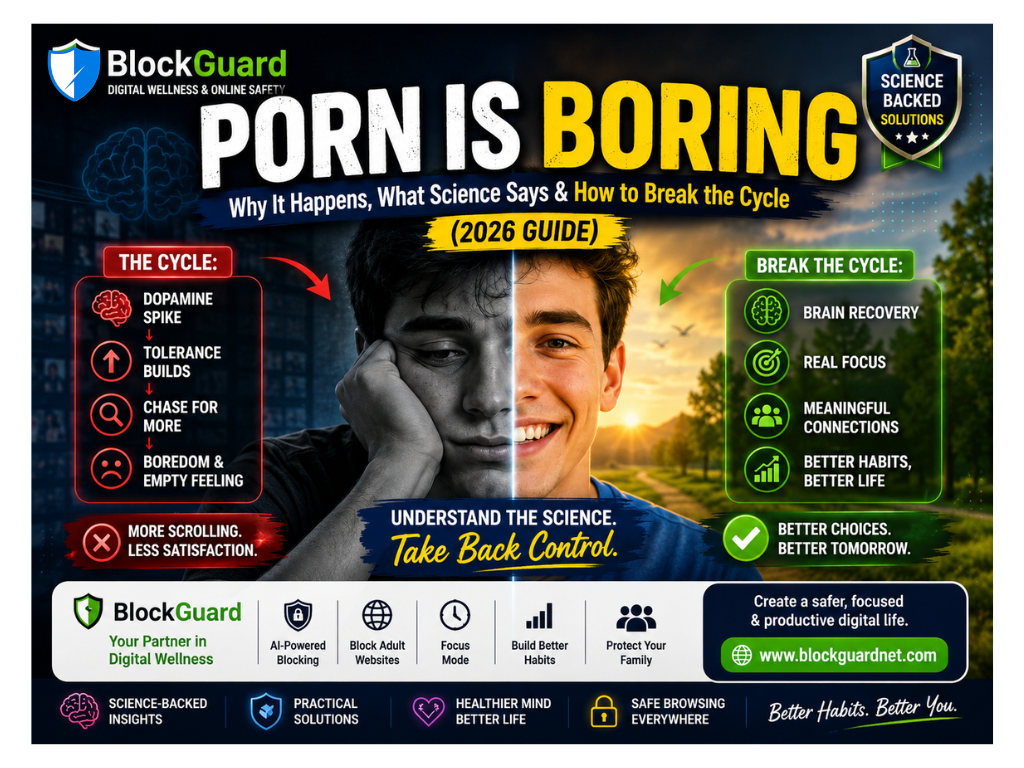
In short: Porn becomes boring because your brain adapts to the high dopamine stimulation, leading to desensitization and a need for greater novelty to achieve the same reward.
Introduction
Have you ever found yourself thinking, “Why is porn so boring now?” You’re not alone. Millions of people experience this strange paradox: they keep watching, but the excitement fades. You might find yourself clicking through video after video, searching for something new, but nothing feels as thrilling as it used to.
Key Takeaways:
- Porn boredom is a normal psychological response, not a personal failing
- Your brain’s reward system adapts to repeated stimulation through a process called habituation
- Dopamine desensitization and tolerance are key drivers of the experience
- Recovery is possible through brain rewiring and healthier digital habits
- Tools like BlockGuard can help create an environment for lasting change
This comprehensive guide will explain the 15 science-backed reasons why porn becomes boring, what happens inside your brain, and most importantly, how to break the cycle and recover.
Section 1: What Does “Porn Is Boring” Really Mean?
When people ask “why is porn so boring,” they’re usually describing a feeling of emotional flatness or a loss of excitement. This is about brain adaptation, not the content itself.
The Psychology Behind Porn Boredom
Boredom is a signal that you’re not genuinely engaged. Many people turn to porn as a passive distraction from boredom, but this often backfires. Consuming porn is a one-way interaction where you’re a viewer, not a participant, which can actually increase feelings of boredom over time.
The Brain Adaptation Process
Your brain is wired to notice new things. When you watch porn, it triggers a large dopamine release. But with repeated exposure, your brain adapts through habituation—the process of getting used to a stimulus so it loses its power to grab attention.
How the Reward System Changes
The brain’s reward system evolved to motivate behaviors essential for survival: eating, socializing, and reproducing. Porn can hijack this system by providing a supernormal stimulus—an unnaturally intense and easy way to trigger a dopamine rush. Over time, the system becomes less sensitive.
The Novelty-Seeking Cycle
A key feature of porn boredom is the urge to seek novelty. You may click from video to video, searching for something more extreme. This is because the brain learns that new things mean more dopamine. But constant novelty-seeking leads to habituation to novelty itself, making it harder to find anything satisfying.
In short: Porn boredom happens because your brain’s reward system adapts to the high stimulation, building tolerance and driving a cycle of novelty-seeking that becomes increasingly unsatisfying.
Section 2: 15 Science-Backed Reasons Porn Starts Feeling Boring
Here are the 15 most common and scientifically supported reasons why porn loses its excitement over time.
Reason 1: Dopamine Desensitization
The Science: Your brain’s dopamine receptors become less sensitive due to overstimulation. What once felt exciting now feels ordinary. This is your brain’s protective mechanism against being overwhelmed.
The Evidence: Studies show frequent porn users have reduced response to sexual images, a clear sign of desensitization. Research from the Max Planck Institute found that individuals who consumed more pornography showed less brain activation in reward regions when viewing sexual images.
Real-Life Example: A person might find that a video they once found thrilling now barely holds their attention for more than a few seconds.
Action Tip: Take a break. A 30-90 day “reboot” can help restore your brain’s sensitivity to natural rewards.
Reason 2: Dopamine Tolerance
The Science: Just like with drugs or alcohol, you can build tolerance to porn’s effects. You need more frequent or intense content to achieve the same level of arousal.
The Evidence: Research published in Neuropsychopharmacology shows that repeated dopamine stimulation leads to decreased receptor density, meaning more stimulation is required to produce the same effect.
Real-Life Example: You might start with mainstream content and gradually move to more niche or extreme categories.
Action Tip: Recognize this as a sign your brain is adapting, not a reflection of your character. Understanding the science empowers change.
Reason 3: The Coolidge Effect
The Science: Named after a story about President Coolidge, this is the phenomenon where males show renewed interest in new sexual partners. This evolutionary mechanism drives novelty-seeking.
The Evidence: Research demonstrates that the Coolidge effect is mediated by dopamine and is a fundamental biological drive that porn exploits.
Real-Life Example: You find yourself clicking from one video to the next, never satisfied with what you’re watching.
Action Tip: Recognize that this is a biological drive, not a sign you need more extreme content.
Reason 4: Escalation
The Science: Escalation is the pattern where users need more extreme, shocking, or taboo material to get the same dopamine hit. This can be frightening if you explore content that conflicts with your values.
The Evidence: A 2025 study in the Journal of Sex & Marital Therapy found that many porn users end up viewing content they previously found off-putting, driven by the need for novelty.
Real-Life Example: A person progresses from softcore to hardcore material, then to content they previously considered disturbing.
Action Tip: If you’re experiencing escalation, consider it a sign your brain is chasing dopamine, not a reflection of your true desires.
Reason 5: Habit Loop Formation
The Science: Porn can become a default behavior—a habit triggered by boredom, loneliness, stress, or even a phone notification. The habit loop (trigger, behavior, reward) becomes so ingrained that the behavior is no longer about pleasure but routine.
The Evidence: Problematic Pornography Use (PPU) research shows it’s often driven by habit and emotional avoidance, not by sexual desire.
Real-Life Example: You automatically open an incognito window when you feel stressed after a bad day.
Action Tip: Identify your triggers. Do you watch when bored? Stressed? Lonely? Once you know the trigger, find a healthier response.
Reason 6: Emotional Burnout
The Science: Porn involves intense emotions followed by feelings of shame, guilt, or emptiness. This cycle leads to emotional burnout, making the experience draining rather than enjoyable.
The Evidence: A 2025 study in Archives of Sexual Behavior found PPU is strongly linked to shame, guilt, and depression, which are characteristic of emotional exhaustion.
Real-Life Example: After watching, you feel anxious and regretful instead of relaxed.
Action Tip: Practice self-compassion. Burnout means you need to rest and heal, not punish yourself.
Reason 7: Stress Escalation
The Science: Many use porn to cope with stress. While offering temporary relief, it doesn’t solve the root cause and can create new problems.
The Evidence: A 2026 study found stress is a significant driver for porn use, especially among those prone to boredom and emotional avoidance.
Real-Life Example: You use porn to relax after work, but it only adds to anxiety about the habit.
Action Tip: Try healthier stress-management techniques like exercise, walking, or talking to a friend.
Reason 8: Loneliness Reinforcement
The Science: Loneliness drives people toward porn as a poor substitute for real connection. But because porn is one-way, it reinforces feelings of isolation.
The Evidence: Research consistently shows loneliness is a common trigger for PPU, serving as an avoidance coping strategy that worsens the feeling of isolation.
Real-Life Example: You feel disconnected, so you watch porn to feel a temporary, false sense of intimacy.
Action Tip: Focus on building real-world connections. Join a club, reach out to an old friend, or volunteer.
Reason 9: Changing Values and Cognitive Dissonance
The Science: As you grow, your values might shift. You may become aware of ethical concerns or decide porn doesn’t align with who you want to be. This cognitive dissonance makes the experience feel wrong and boring.
The Evidence: Shame and guilt related to porn use that conflicts with personal values compound psychological distress.
Real-Life Example: You learn about exploitation in the porn industry and can no longer enjoy it.
Action Tip: Align your digital habits with your values. It’s okay to decide to stop entirely.
Reason 10: Real Intimacy Becoming More Meaningful
The Science: As you mature or experience a loving relationship, the artificiality of porn becomes obvious. The lack of emotional connection, mutual respect, and vulnerability makes porn feel empty in comparison.
The Evidence: Porn can condition viewers to prefer fantasy over the complexity of real intimacy.
Real-Life Example: After a deeply connected relationship, porn feels hollow and unfulfilling.
Action Tip: Nurture your real-world relationships. Invest time and energy in building genuine intimacy.
Reason 11: Brain Structure Changes (Neuroplasticity)
The Science: Current evidence suggests porn use can change brain structure. Neuroplasticity means your brain rewires itself based on experience.
The Evidence: A 2025 study found frequent porn use correlated with reduced grey matter in decision-making and impulse control regions. Another study showed altered connections between reward and executive control networks.
Real-Life Example: You find it harder to resist urges and make decisions about your behavior.
Action Tip: The brain’s plasticity also means it can recover. Reducing exposure allows the brain to rewire toward healthier patterns.
Reason 12: Reward Prediction Error Disruption
The Science: The brain constantly makes predictions. When a reward is better than expected, it releases more dopamine. With porn, the brain starts to expect the reward, reducing the prediction error and the associated excitement.
The Evidence: Research on addiction shows this is how tolerance and habituation develop—the brain’s prediction system adjusts to the high level of stimulation.
Real-Life Example: You know exactly what will happen, so there’s no surprise or excitement.
Action Tip: Break the predictability. Introduce new, unfamiliar healthy activities to create positive reward prediction errors.
Reason 13: Emotional Dysregulation
The Science: Using porn to regulate negative emotions can lead to emotional dysregulation. You lose the ability to manage emotions naturally without external stimulation.
The Evidence: A 2026 study published in Archives of Sexual Behavior found PPU often begins as emotional regulation and develops into a compulsion driven by needing to manage distress.
Real-Life Example: You can’t relax without porn; any negative feeling triggers the urge.
Action Tip: Learn healthy emotional regulation techniques like journaling, mindfulness, and breathing exercises.
Reason 14: Relationship Strain
The Science: When porn affects relationships, it creates additional stress and guilt, making the experience less enjoyable and more associated with negative outcomes.
The Evidence: Research consistently links PPU to relationship dissatisfaction, reduced intimacy, and increased conflict.
Real-Life Example: Your partner expresses concern about your porn use, and now watching feels secretive and shameful.
Action Tip: Be honest with yourself and your partner. Open communication can reduce the shame that fuels the cycle.
Reason 15: Loss of Agency and Autonomy
The Science: When you feel you’ve lost control over your behavior, it diminishes self-worth and makes the experience less enjoyable. You’re watching because you feel you have to, not because you choose to.
The Evidence: Research on motivation shows that autonomous choice is essential for positive experiences. When behavior feels compelled, satisfaction decreases.
Real-Life Example: You watch porn even when you don’t want to, feeling like you have no choice.
Action Tip: Reclaim your autonomy. Deciding to take a break is a powerful act of self-determination.
Section 3: What Happens Inside the Brain?
Understanding the neuroscience empowers you to make informed choices. Here’s a clear breakdown.
The Dopamine Response Explained
Dopamine is a neurotransmitter central to the brain’s reward system. It’s released when you experience pleasure, motivating you to repeat the behavior. Watching porn triggers a large, rapid dopamine release.
The Brain’s Reward Prediction System
Your brain is a prediction machine. When a reward is better than expected, it releases more dopamine (reward prediction error). With porn, the brain learns to expect the reward, so the prediction error diminishes, and so does the excitement.
The Cue-Response Habit Loop
Habits form through a three-step process. A cue (feeling stressed, seeing an ad) triggers a response (watching porn), which leads to a reward (dopamine rush). The brain learns this loop, and the cue automatically triggers the desire.
Neuroplasticity: The Brain Can Rewire
Current evidence suggests porn use can physically change the brain. This is neuroplasticity. A 2025 study found frequent porn users showed reduced grey matter in brain regions responsible for decision-making and impulse control. Research also indicates altered connectivity between the reward system and the prefrontal cortex, which is responsible for self-control.
Important Note on Confidence: While these findings are significant, some research is still developing. Not all scientists agree on the cause-and-effect relationship. Current evidence suggests, but doesn’t definitively prove, that these brain changes are caused by pornography use. Other factors like pre-existing stress or mental health conditions could also play a role.
The Recovery Process
The brain’s neuroplasticity means it can recover. Reducing exposure allows the brain to rewire toward healthier patterns. This is why a period of abstinence—often called a “reboot”—can restore dopamine sensitivity and improve impulse control.
Section 4: Are You Chasing Novelty Instead of Enjoyment?
This checklist helps you reflect on your habits. These are common signs of novelty-seeking rather than genuine enjoyment.
| Sign | Indicator |
|---|---|
| Rapid Skipping | You click through videos faster and faster, never settling on one. |
| Multiple Tabs | You have multiple windows open simultaneously. |
| Dissatisfaction | You often feel unsatisfied or frustrated after a session. |
| Escalation | You’re seeking more extreme or unusual content. |
| Automatic Behavior | You watch out of habit even when not particularly aroused. |
| Post-Viewing Guilt | You frequently feel shame, regret, or emptiness afterward. |
| Time Wasting | You spend more time searching than watching. |
| Feels Like a Chore | Watching feels like something you have to do, not want to do. |
If you recognize several of these signs, you may be stuck in a novelty-seeking loop.
Section 5: Can Porn Become Less Enjoyable Over Time?
Yes. For many, the enjoyment of porn diminishes with repeated use. This is often associated with Problematic Pornography Use (PPU) .
What Is Problematic Pornography Use (PPU)?
PPU is characterized by a loss of control over porn use, leading to negative consequences in your life, relationships, and mental health. Frequency alone is not a good indicator of PPU. You can watch frequently without problems, or less frequently and feel it’s a problem.
Compulsive Behaviors Explained
PPU often involves compulsive behaviors, where you feel a strong urge to engage despite negative consequences. Research shows this is often driven by emotional avoidance—using porn to escape from feelings like stress, loneliness, or anxiety.
Understanding Behavioral Addiction Models
The concept of addiction is used by some experts to understand PPU, while others prefer a compulsive behavior model. Here’s what we know:
- The World Health Organization (WHO) recognizes Compulsive Sexual Behavior Disorder (CSBD) as a mental health condition characterized by a persistent pattern of failure to control intense, repetitive sexual impulses or urges.
- “Porn addiction” remains an active area of research. It is not formally recognized in the DSM-5, but many clinicians find the concept useful. The debate continues on whether PPU is best understood as a behavioral addiction, a form of impulse control disorder, or a manifestation of other underlying mental health issues.
Section 6: Expert Insights
Quote from a Clinical Psychologist
“The data suggests that for many, pornography use isn’t a sign of a disordered sexual appetite, but a maladaptive coping mechanism for things like stress, anxiety, or loneliness. The boredom isn’t with the content, but with the experience of needing the content to regulate an emotional state.”
— Dr. Nicole Prause, Neuroscientist
Quote from a Neuroscience Researcher
“The human brain is a novelty-seeking machine. When the novelty fades and the behavior becomes a habit, the brain adapts, leading to a significant drop in the reward response. This is when it can start to feel ‘boring.'”
— Dr. Robert Weiss, Expert on Intimacy and Addiction
Summary from Clinical Psychology Literature
Research indicates that Problematic Pornography Use (PPU) is better predicted by why you use porn (e.g., to cope with negative emotions) rather than how often you use it. This highlights the importance of addressing underlying psychological issues.
Section 7: Latest Research (2025-2026)
Recent evidence continues to refine our understanding of pornography use.
2025 Study: Motivational Pathways
A 2025 study published in Archives of Sexual Behavior found that individuals who consider their porn use problematic often had pre-existing problems (like emotional distress) before their use escalated. Their pornography use eventually changed from being for enjoyment to being a form of emotional regulation.
Key Finding: This suggests PPU is often a symptom of deeper issues, not just a problem in itself.
2026 Study: Distinct Psychological Profiles
A 2026 study in the Journal of Sex & Marital Therapy confirmed that “frequent and problematic pornography use reflect distinct psychological profiles rather than points along a severity continuum.” People who use porn frequently without distress are psychologically different from those who feel their use is problematic.
Key Finding: Your relationship with porn matters more than the frequency.
Limitations of Current Research
It’s crucial to be cautious when interpreting research:
- Correlation is not causation: Many studies show a link between porn use and brain changes, but they can’t definitively prove porn causes these changes. Other factors could be at play.
- Self-reporting is common: Much of the data comes from people reporting their own habits, which isn’t always reliable.
- The field is developing: There’s ongoing debate about the best way to define and diagnose PPU.
Confidence Statement: Based on the current weight of evidence, it’s reasonable to conclude that for some individuals, excessive pornography use can lead to desensitization, tolerance, and diminished well-being. However, many people use pornography without negative effects.
Section 8: A Balanced View of Pornography’s Effects
| Point | What the Evidence Shows |
|---|---|
| Not Everyone Is Affected | Many people consume porn without any negative effects. |
| Personal Relationship Matters | The impact depends more on whether you feel in control than on frequency. |
| It Can Be a Coping Mechanism | Often, it’s an attempt to regulate emotions like stress, not a sexual desire. |
| Brain Changes Are Possible | Some studies show changes in brain structure, but these are still debated. |
| Recovery Is Possible | The brain’s plasticity means it can recover with reduced exposure. |
| Ethical Concerns Exist | Many question the ethics of the mainstream porn industry, which may affect how you feel about it. |
Section 9: Common Myths vs. Facts
| Myth | Fact |
|---|---|
| “Porn is boring because I’m watching the wrong thing.” | Boredom is usually a sign of brain adaptation (desensitization), not a content problem. |
| “I need to find more extreme content to feel excited again.” | This is novelty-seeking and escalation. It often makes the problem worse. |
| “Porn addiction is a universally recognized medical condition.” | The WHO recognizes Compulsive Sexual Behavior Disorder (CSBD) , but “porn addiction” remains an active area of research. |
| “Quitting porn is purely about willpower.” | Willpower isn’t enough. Changing your environment with tools like a blocker is essential. |
| “Everyone who watches porn develops problems.” | Research shows many consume porn without any negative effects. It’s loss of control that defines problematic use. |
| “If I don’t watch often, it’s not a problem.” | Frequency is less important than the impact. If it’s causing distress, it’s worth addressing. |
| “Boredom with porn means I should try something new.” | Boredom is often a signal to stop, not escalate. Escalation can lead to more extreme content. |
Section 10: Warning Signs of Problematic Pornography Use
| Warning Sign | Key Indicator |
|---|---|
| Loss of Control | You try to stop but find you’re unable to. |
| Neglecting Activities | You sacrifice time with friends, family, or hobbies to watch porn. |
| Excessive Time | You spend significantly more time watching than intended. |
| Negative Consequences | It harms your relationships, work, or academic performance. |
| Emotional Coping | You use porn primarily to escape negative emotions. |
| Compulsivity | You watch porn even when you don’t want to or have no sexual desire. |
| Shame and Guilt | You feel distress and shame about your use afterward. |
If you recognize several of these signs, consider seeking professional help.
Section 11: Recovery Roadmap
This roadmap provides a step-by-step guide to breaking the cycle. Recovery is possible and begins with one small, consistent action.
Step 1: Acknowledge and Understand
Recognize your habits and the science behind them. Understanding dopamine, habituation, and the habit loop removes the shame and empowers change. It’s not a moral failing; it’s biology.
Step 2: Identify Your Triggers
Ask yourself why you watch. Is it stress? Boredom? Loneliness? Keep a journal for a week to track what you feel before you watch. Identifying the cue is the first step to breaking the habit loop.
Step 3: Create a Friction-Free Environment
Willpower alone is not enough. Install a reliable porn blocker like BlockGuard to make the right choice easy. Removing the option in weak moments is a proven strategy for behavior change.
Step 4: Build Your Toolkit of Alternatives
Have a list of healthy activities ready for when an urge strikes. This might be going for a walk, calling a friend, reading, exercising, or meditating. Having a go-to activity makes it easier to resist.
Step 5: Implement a Daily Check-in
Use a journal to track your feelings and progress. Write down what you’re feeling, what triggered any urges, and how you responded. This builds self-awareness and helps you see your progress.
Step 6: Seek Support
Consider joining a support community or speaking with a therapist. A professional can help uncover root causes like stress, loneliness, or trauma. Shared experience in a community can be powerfully motivating.
Step 7: Practice Self-Compassion
Relapses happen. They don’t erase your progress. Learn from them and continue your journey. Recovery is not a straight line; every step forward, no matter how small, is a victory.
Section 12: Your Trigger Response Toolkit
| Trigger | What to Do | Actionable Solutions |
|---|---|---|
| Stress | “I need to relax.” | 1. Deep breathing or meditation (5-10 minutes). 2. Go for a short walk. 3. Take a warm bath. |
| Loneliness | “I feel disconnected.” | 1. Call a supportive friend. 2. Join a meetup or class. 3. Volunteer. 4. Pet your animal. |
| Boredom | “I have nothing to do.” | 1. Pick up a book. 2. Start a new hobby. 3. Tidy your room. 4. Learn a new skill. |
| Urge | “I feel a strong craving.” | 1. Urge Surfing: Acknowledge the urge without acting on it. 2. Distract yourself for 10 minutes. 3. Exercise for 5 minutes. 4. Use your blocker’s “Long Sentence Protection.” |
Section 13: Healthy Alternatives to Replace the Habit
Replacing the habit with healthier activities is crucial for lasting change. Here are some ideas.
| Category | Examples | Why It Helps |
|---|---|---|
| Physical | Exercise, walking, yoga, dancing | Releases natural dopamine, reduces stress, uses restless energy. |
| Mental | Reading, learning a new skill, puzzles, journaling | Engages your mind constructively, creates accomplishment, builds knowledge. |
| Emotional | Meditation, therapy, deep breathing, spending time with friends | Builds resilience, creates genuine connections, addresses root causes. |
| Digital | Digital detox, screen time limits, website blocker, wellness podcasts | Creates a safer online environment, reduces distractions, increases intentionality. |
Section 14: How BlockGuard Can Help You Recover
Creating a friction-free environment is one of the most effective strategies for breaking a bad habit. Willpower alone is often not enough. By making it harder to access porn, you increase your chances of success in those vulnerable moments.
Our Experience Supporting Digital Wellness
After working with thousands of users trying to reduce digital distractions and build healthier habits through tools like BlockGuard, we’ve observed some common patterns. Many people initially report searching for stronger or more extreme content, believing it will solve their boredom, only to find it doesn’t work.
A few weeks into their journey to reduce consumption, they frequently contact us to share a surprising realization: they feel a sense of relief and emotional reconnection, not deprivation. This is a clear sign that the brain is rebalancing, and the initial boredom was a signal to change, not a need to escalate.
What BlockGuard Provides
BlockGuard is a completely free tool designed to help you create a safer, more focused online environment. Here are its key features:
- Porn Blocker: Instantly block access to millions of porn websites.
- Safe Search Enforcement: Reduce explicit images, videos, and search results.
- Custom Blocklists: Block specific websites, URLs, and keywords that lead to distractions.
- Focus Mode & Accountability: Features like “Long Sentence Protection” make it harder to impulsively turn the blocker off.
- Cross-Platform Protection: Available as a browser extension for Chrome and Edge, a mobile app for Android, and a desktop application.
- Block Shorts, Reels & TikTok: Reduce endless scrolling and reclaim your time.
This tool works quietly in the background, making the right choice the easiest one. It’s one part of a comprehensive strategy for digital wellness, not a magic solution.
Section 15: Frequently Asked Questions (FAQs)
Here are 15 common questions people have about porn boredom and recovery.
Q1: Why is porn so boring?
A1: Porn becomes boring due to brain adaptation. Your reward system gets used to the stimulation, leading to habituation and dopamine tolerance. This makes it difficult to get the same level of excitement, so you may need more novelty to feel anything.
Q2: Why doesn’t porn excite me anymore?
A2: This is often a sign of desensitization. Your brain’s dopamine receptors have become less sensitive from overexposure. What once gave you a rush now feels flat because you’ve developed a tolerance.
Q3: Can your dopamine recover from porn use?
A3: Yes, your brain is neuroplastic. Current evidence suggests a period of abstinence can help restore dopamine sensitivity. This process is often called a “reboot.”
Q4: How long does it take for your brain to recover from porn?
A4: There’s no set timeline. A common recommendation is a 30-90 day period of abstinence, but you may start feeling benefits in as little as a few weeks. The process isn’t linear.
Q5: Can “porn is boring” be a sign of addiction?
A5: It can be. Boredom and the need for novelty are signs of habituation, a component of behavioral addiction models. This is often associated with Problematic Pornography Use (PPU).
Q6: Does quitting porn help with boredom?
A6: Yes, but indirectly. Quitting helps break the cycle of seeking passive, unfulfilling stimulation. This motivates you to find more meaningful activities, which are better at relieving boredom long-term.
Q7: Is it normal to get bored of porn?
A7: Yes, it’s a very common experience. Many people find the novelty and stimulation wear off over time as their brain adapts. You’re not alone.
Q8: What does a porn “reboot” mean?
A8: It’s a period of abstinence from pornography and masturbation. The goal is to let your brain’s reward system reset, making you more sensitive to natural rewards like real-world intimacy.
Q9: Can porn cause erectile dysfunction (ED)?
A9: Some experts suggest a link, called porn-induced erectile dysfunction (PIED) . The theory is that the brain becomes conditioned to the hyper-stimulation of porn, making real-life intimacy less stimulating.
Q10: What is “novelty seeking” behavior?
A10: It’s the common urge to constantly search for something new, more extreme, or unusual in porn to get a dopamine rush. This leads to disappointment with familiar content.
Q11: How can I tell if my porn use is problematic?
A11: It’s problematic if you feel you’ve lost control, it negatively affects your relationships, work, or mental health, or you continue despite wanting to stop. Self-reflection is key.
Q12: What are the signs of porn desensitization?
A12: Signs include needing more extreme content to get aroused, feeling regular sex is uninteresting, and needing more stimulation (or being less aroused by it).
Q13: Is there a link between porn and anxiety?
A13: Research shows an association. People who compulsively consume porn have higher rates of anxiety and stress. Porn can be a short-term coping mechanism that ultimately increases anxiety.
Q14: How does stress affect porn use?
A14: Stress is a common trigger. People turn to porn to escape or self-soothe. However, this creates a cycle where shame or guilt about using porn adds to the stress.
Q15: What are the first steps to quitting porn?
A15: First, understand your reasons for quitting. Second, identify your triggers. Then, install a porn blocker like BlockGuard, find healthy alternatives, and consider seeking support from a therapist or support group.
Conclusion
The feeling that “porn is boring” is a powerful sign from your brain that your current digital habits are no longer serving you. This isn’t a moral failing; it’s a predictable, scientific response to overstimulation. The constant chasing of novelty has led to desensitization, making the experience feel flat and unfulfilling.
The good news is that you can break this cycle. By understanding the neuroscience of dopamine and habituation, you can take back control. Start by replacing passive consumption with active engagement. Build real-world connections, find healthy outlets for stress, and use tools like BlockGuard to create a safer digital environment. This helps reduce friction and supports you in making healthier choices.
Your journey to recovery is about more than just stopping a habit. It’s about reclaiming your time, energy, and brain power for the things that truly matter to you.
References
- Bőthe, B., et al. (2025). “Motivational Pathways Diverge Between Frequent and Problematic Pornography Use.” Journal of Sex & Marital Therapy.
- Grubbs, J. B., et al. (2025). “Displacing Problems: A Constructivist Grounded Theory of Problematic Pornography Use.” Archives of Sexual Behavior.
- Voon, V., et al. (2014). “Neural correlates of sexual cue reactivity in individuals with and without compulsive sexual behaviours.” PLoS ONE.
- Kühn, S., & Gallinat, J. (2014). “Brain structure and functional connectivity associated with pornography consumption: The brain on porn.” JAMA Psychiatry.
- World Health Organization. (2025). “Compulsive Sexual Behavior Disorder.” ICD-11.
- Prause, N., et al. (2021). “Data do not support the claim that pornography affects the brain.” Socioaffective Neuroscience & Psychology.
- Weiss, R. (2020). “Sex Addiction 101.” Psychology Today.
- American Psychological Association. (2020). “Understanding and Treating Sexual Compulsivity.”
- Cleveland Clinic. (2024). “Pornography Addiction: A Comprehensive Overview.”
Get Started with BlockGuard
Free Chrome Extension: Install it here
Free Android App: Install it here
Official site: blockguardnet.com
Related Articles
- How to Block YouTube
- How to Block Instagram
- Reduce Screen Time
- Block a Website
- Best Website Blocker
- Adult Content Blocker
Start your journey toward a safer, more controlled digital environment today.