Key Takeaways {#key-takeaways}
- Billie Eilish’s story is a personal account, not scientific evidence. Her experience of distress from early pornography exposure is real but not universal.Billie Eilish Pornography
- Scientific research shows 3.2%–16.6% of people experience problematic pornography use (PPU), characterized by loss of control and negative consequences.
- The brain’s reward system is involved, but pornography does not cause permanent “brain damage.” It can, however, desensitize dopamine receptors in some heavy users.
- The medical community prefers “problematic pornography use” over “porn addiction.” The WHO recognizes Compulsive Sexual Behavior Disorder (CSBD) in the ICD-11.
- Adolescent brains are more vulnerable due to ongoing development of the prefrontal cortex and elevated dopamine production.
- Moral incongruence—the conflict between behavior and personal values—is a key factor in pornography-related distress.
- Recovery is possible through therapy (CBT is first-choice), digital tools, and healthy habit replacement.
- Early, open conversations about sex and media literacy are the most effective tools for parents.
1. Who Is Billie Eilish? {#who-is-billie-eilish}
Billie Eilish is a Grammy-winning singer-songwriter who became the youngest person in history to win all four major Grammy categories in the same year at age 18. She is known for her dark, introspective lyrics and has been open about mental health, body image, and her personal struggles.
2. What Did Billie Eilish Say About Pornography? {#what-billie-eilish-said}
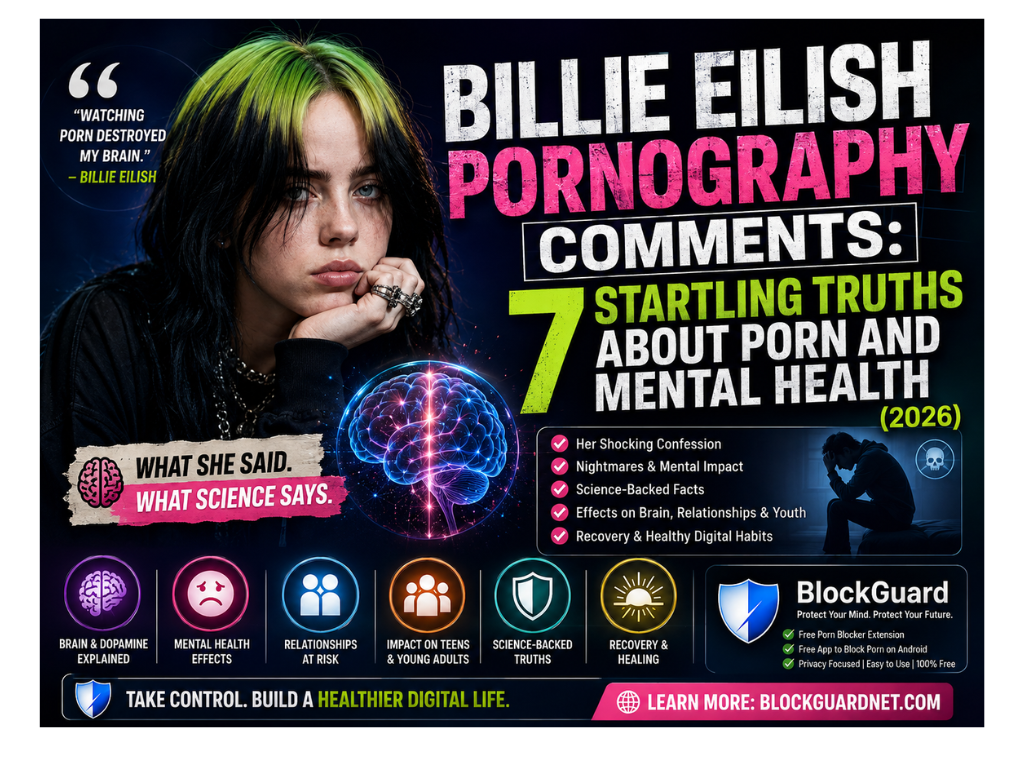
In a December 2021 interview with Howard Stern, Billie Eilish revealed she began watching pornography at age 11 and described the experience as damaging, stating it “really destroyed my brain” and gave her nightmares. She called pornography “a disgrace” and said it warped her expectations of sex and bodies. She also shared that the first few times she had sex, she “was not saying no to things that were not good” because she thought that’s what she was “supposed to be attracted to.”
| Topic | Eilish’s Exact Words |
|---|---|
| Starting age | “I started watching porn when I was, like, 11” |
| Impact on brain | “I think it really destroyed my brain” |
| Porn as a concept | “I think porn is a disgrace” |
| Nightmares | She suffered nightmares and sleep paralysis because of violent content |
| Body image | “No vaginas look like that. Women’s bodies don’t look like that. We don’t come like that” |
| Early sex experiences | “The first few times I, you know, had sex, I was not saying no to things that were not good” |
| Escalation | “It got to a point where I couldn’t watch anything else unless it was violent” |
3. The Howard Stern Interview: Full Context {#howard-stern-interview}
Billie Eilish appeared on The Howard Stern Show on Sirius XM radio on December 13, 2021, to promote her album Happier Than Ever. The conversation turned to her song “Male Fantasy,” which deals with using pornography to cope with emotional pain. Eilish explained that she started watching porn at 11 to feel “one of the boys” and thought she was “really cool for not having a problem with it.” She described the content she encountered as “violent” and “abusive” and said she suffered nightmares and sleep paralysis as a result.
Her Motivation for Watching
- To feel “one of the boys”
- To feel “really cool for not having a problem with it”
- To fit in and normalize something she didn’t understand at 11
- She even complained to her mother about a friend’s mom who wouldn’t let her child watch porn, asking: “How else am I supposed to learn how to have sex?”
4. The Song “Male Fantasy” Explained {#male-fantasy-explained}
“Male Fantasy” explores using pornography as a distraction from emotional pain after a breakup. The song opens with the lyrics: “Home alone, tryin’ not to eat / distract myself with pornography.” Eilish has said the track is partly autobiographical and describes her struggles with pornography. The song was inspired by a conversation about how “stupid and unrealistic” pornography is, and she described writing it as “cathartic.”
5. Why She Said Pornography “Destroyed My Brain” {#why-destroyed-my-brain}
Billie Eilish’s statement “destroyed my brain” describes her personal experience of emotional and psychological distress from early, repeated exposure to pornography. She reported the content caused nightmares, warped her expectations of sex and body image, and influenced her to accept things during early sexual experiences that she later regretted.
What “Destroyed My Brain” Meant to Eilish:
- Severe nightmares and sleep paralysis
- Distorted expectations of sex, bodies, and consent
- Difficulty saying no to things that were “not good” during early sexual experiences
- A sense of anger and devastation at her younger self
- A need to return to therapy to process the experience
Experts in a 2025 academic study analyzing her case noted that celebrity confessions about pornography are often framed in public discourse as narratives of harm and a call for regulation or self-regulation. Her story is often cited in debates about the impact of early pornography exposure on adolescent development.
6. The Nightmares and Sleep Paralysis She Described {#nightmares-described}
Billie Eilish reported suffering nightmares and sleep paralysis after watching pornography, specifically due to the violent and abusive content. She described the content as “so violent and abusive.” She also stated that her consumption “got to a point where I couldn’t watch anything else unless it was violent.” The nightmares appear to stem from the emotional distress caused by repeatedly viewing explicit and aggressive material she was developmentally unprepared for.
7. Dopamine and the Brain Reward Pathway {#dopamine-reward-pathway}
Pornography use engages the brain’s reward system through dopamine release, fueling desire and craving. With high-speed internet pornography, the constant novelty can lead to “tolerance” and “escalation”—needing more extreme content for the same effect.
How the Dopamine System Works:
- Dopamine release: Pornography triggers dopamine, a neurotransmitter associated with pleasure and reward.
- Desensitization: The brain protects itself from flooding by desensitizing dopamine receptors.
- Tolerance: Users require more frequent use or more extreme content to achieve the same effect.
- Escalation: Users may step into content they once found disgusting or immoral.
- Reduced pleasure elsewhere: The brain may struggle to access pleasure in other areas of life.
What Brain Research Shows:
A 2014 study found that frequent pornography consumption was linked to a reduction of gray matter in the prefrontal cortex, which impacts decision-making and is likely related to the urges and cravings associated with escalated use.
Expert Insight: “When the brain is flooded with dopamine, it protects itself… it will desensitize the brain to the flooding of dopamine, and so users will then require more frequent use or exacerbating content.”
8. Scientific Evidence on Pornography and Mental Health {#scientific-evidence}
Scientific research shows a range of outcomes from pornography consumption, with some people experiencing no negative effects and others developing problematic patterns that can harm mental health. Studies estimate that problematic pornography use (PPU) affects between 3.2% and 16.6% of the population.
Key Statistics
- 40%–90% of people have used pornography
- 3.2%–16.6% meet criteria for problematic use
- PPU is more common in males
- Average age of PPU users: 24.7 years
- At least 73% of teens have seen porn, with 58% saying by accident
- 53% of boys and 39% of girls believe pornography is a realistic depiction of sex
The scientific consensus is not that all pornography use is harmful, but that for a subgroup of users, compulsive consumption is linked to distress and impairment.
9. What Research Agrees On {#research-agrees}
Research generally agrees that problematic pornography use (PPU) is associated with depression, anxiety, relationship difficulties, and emotional distress, especially in individuals with high moral incongruence. Studies consistently link PPU to higher scores on depression, anxiety, and stress, as well as reduced relationship satisfaction and commitment. A 2025 EMA study found that for individuals with high moral incongruence, pornography use led to “transient increases in shame, guilt, difficulty thinking, relationship disconnectedness, craving, and mood deterioration” that persisted for hours.
Areas of Scientific Agreement
| Area | Consensus |
|---|---|
| PPU exists | Yes, recognized as CSBD in ICD-11 |
| PPU linked to depression | Consistent association |
| PPU linked to anxiety | Consistent association |
| PPU linked to relationship issues | Consistent association |
| Moral incongruence matters | Strong factor in distress |
| High-frequency use ≠ PPU | Frequency alone doesn’t define it |
10. What Research Disagrees On {#research-disagrees}
The scientific community is still divided on whether PPU should be classified as a behavioral addiction or an impulse control disorder, and on the direction of causation. Some neuroscientific findings suggest “proximity to addiction disorders,” showing similarities in brain function between PPU and substance use disorders. Other researchers argue the evidence is “not consistent with addiction models.”
Key Disagreements:
- Causation vs correlation: Does PPU cause mental health issues, or is it a symptom?
- Addiction vs impulse control: Should it be classified with addictions or with impulse control disorders?
- Moral incongruence as driver: Is moral incongruence the primary source of distress?
- Addiction narrative: Does calling it “addiction” help or harm recovery?
The ICD-11’s classification of CSBD as an impulse control disorder rather than an addiction reflects this ongoing debate.
11. Pornography vs Compulsive Pornography Use {#pornography-vs-compulsive}
Compulsive pornography use is defined by a pattern of consumption that causes distress and functional impairment, marked by an inability to control use despite negative effects. The distinction from any pornography use is critical. Problematic use involves loss of control, negative consequences, and distress, whereas many people view pornography without experiencing these issues.
Key Distinctions
| Aspect | Any Pornography Use | Problematic Use |
|---|---|---|
| Control | User chooses when to use | User feels unable to stop |
| Impact | Neutral or positive | Negative consequences |
| Distress | Minimal or none | Significant distress |
| Frequency | Variable | Excessive or compulsive |
| Functional impairment | None | Work, relationship, social difficulties |
12. Pornography vs Addiction: The Medical Debate {#addiction-debate}
The term “porn addiction” is widely used in public discourse but remains debated in medical contexts, where the preferred terms are “problematic pornography use” (PPU) or “Compulsive Sexual Behavior Disorder” (CSBD). The International Society for Sexual Medicine emphasizes that clinical sexologic expertise “is imperative to differentiate and understand the determinants and impact of CSBD.”
Billie Eilish’s use of “addiction” in her interview reflects common experience, but researchers note that “a glaring issue remains: the psychological mechanisms linking pornography use to negative mental health outcomes have not yet been confirmed or quantified.”
The Displacement Theory
A 2025 grounded theory study found that when individuals reached out for information about their pornography use, they were met with an addiction narrative and consequently saw themselves as addicted. This led them to displace their original problems (such as mental health issues or life difficulties) onto the addiction, making recovery more complicated. The study concluded that “pornography is not inherently harmful for the individual; however, many users consider their use to be problematic.”
13. WHO and ICD-11: Compulsive Sexual Behavior Disorder {#who-icd11}
The World Health Organization’s ICD-11 includes Compulsive Sexual Behavior Disorder (CSBD), which can encompass problematic pornography use. CSBD is defined as “a persistent pattern of failure to control intense, repetitive sexual impulses or urges, resulting in repetitive sexual behavior” that causes “marked distress or significant impairment.”
ICD-11 Diagnostic Criteria for CSBD:
- Repetitive sexual activities become a central focus of the person’s life
- Numerous unsuccessful efforts to significantly reduce repetitive sexual behavior
- Continued repetitive sexual behavior despite adverse consequences
- Continued engagement despite deriving little or no satisfaction
- Causes marked distress or significant functional impairment
The Moral Incongruence Exclusion
The WHO adds that “distress that is entirely related to moral judgments and disapproval about sexual impulses, urges, or behaviors is not sufficient to meet this requirement.” This is a crucial distinction for cases like Billie Eilish’s, where some distress may be moral while other distress stems from real impairment.
Expert Insight: The WHO explicitly decided not to use the term “sex addiction” and did not classify CSBD as a disorder due to addictive behaviors because the evidence was not considered strong enough.
14. Brain Development in Adolescents {#adolescent-brain-development}
The adolescent brain is particularly sensitive to reward and novelty, making early and heavy pornography exposure a potential concern. During adolescence, the brain’s prefrontal cortex—responsible for impulse control and decision-making—is still developing.
Why the Teen Brain Is More Vulnerable:
- Elevated dopamine production: A teenager’s brain has more elevated dopamine production and neuroplasticity as it is developing.
- Prefrontal cortex immaturity: The ability to control impulses and make long-term decisions is still developing.
- Neuroplasticity: The brain is highly adaptable, but this also makes it more susceptible to conditioning.
- Sexual script formation: Adolescents are forming their understanding of sex and relationships.
Research Findings:
- Studies show more pornography use during teenage years could indicate more problematic use in adult years.
- Frequent pornography consumption is linked to altered functional connectivity in the prefrontal cortex.
- At least 1 in 3 porn videos show sexual violence or aggression.
- 53% of boys and 39% of girls believe pornography is a realistic depiction of sex.
Expert Insight: “These young people are watching something that’s essentially fantasy. And then having these real-life experiences, there’s a mismatch of expectations… it can be really disturbing, it can be upsetting, it’s misleading.”
15. Mental Health Effects: Anxiety, Depression, and Relationships {#mental-health-effects}
Research consistently links problematic pornography use to a range of negative mental health outcomes, including depression, anxiety, shame, guilt, loneliness, and relationship difficulties.
Mental Health Associations:
- Depression: PPU is consistently associated with higher depression scores.
- Anxiety: Users often report increased anxiety related to their behavior.
- Shame and guilt: These are common, especially when behavior conflicts with personal values.
- Loneliness: PPU is linked to decreased relationship connectedness.
- Suicidal thoughts: Some studies have found associations with suicidal ideation.
Relationship Effects:
- Lower relationship satisfaction and commitment
- Decreased emotional connectedness
- Higher rates of infidelity
- Loss of trust
- Unrealistic expectations
- Decreased interest in partner
Billie Eilish’s reported experiences of nightmares, emotional distress, and relationship impact align with documented outcomes for some heavy, early users. However, these experiences are not universal. It is the loss of control and negative consequences that distinguish problematic use from healthy consumption.
16. Latest 2025–2026 Research {#latest-research}
Recent research has significantly advanced our understanding of problematic pornography use, revealing nuanced mechanisms and challenging some earlier assumptions.
Key 2025 Findings:
- Opponent Process Dynamics (2025 EMA Study)
- For individuals with high moral incongruence, pornography use leads to “transient increases in shame, guilt, difficulty thinking, relationship disconnectedness, craving for sexual intercourse, and mood deterioration.”
- These shifts typically persist for several hours before returning to baseline.
- Evidence of opponent process dynamics in mood may explain how PPU can lead to depression.
- Displacement Theory (2025 Grounded Theory Study)
- Individuals often had distinct problems prior to self-reported PPU.
- They discover “having PPU” by proxy, through an external means.
- When they reach out for information, they are met with an addiction narrative.
- They then displace their original problems onto the “addiction,” making recovery more complex.
- Public Discourse Analysis (2025 New Media & Society)
- Celebrity confessions like Billie Eilish’s are often framed as narratives of harm.
- These narratives feed ongoing policy debates about regulation and self-regulation.
- Media coverage constructs adolescent sexual experiences in particular ways that shape public understanding.
- Brain Fog After Pornography Use
- Studies signal potential evidence for “brain fog” following pornography use in both low and high-incongruence participants.
- Moral Incongruence as a Moderator
- Moral incongruence emerges as a key psychological factor in PPU.
- It is influenced by religious beliefs, cultural norms, conservative sexual values, apprehensions about sexual exploitation, and the potential impact on interpersonal relationships.
17. What Parents Should Know {#what-parents-should-know}
Billie Eilish’s story highlights the importance of early, open conversations about sex, relationships, and online content before exposure occurs. Experts note that adolescents often turn to pornography as a source of sexual information when schools and parents don’t provide adequate education.
Parenting Guidelines by Age:
| Age Range | What Parents Can Do |
|---|---|
| 0–5 years | Start naming body parts correctly. Normalize sexuality language. |
| 5–9 years | Begin dialogue about what they might see online. “You might see naked pictures or videos. If you do, come tell me.” |
| 10+ years | Increase conversations about media literacy and consent. Discuss unrealistic portrayals in pornography. |
Practical Steps:
- Start conversations about sexuality early
- Discuss media literacy: what pornography shows vs reality
- Use digital tools to filter content on family devices
- Encourage open, shame-free communication
- Normalize questions about sex and relationships
- Teach body autonomy and consent
- Monitor online activity without shaming
- Model healthy digital habits
Expert Insight: “When parents are talking with their kids about sexuality and pornography, [it’s important] to really highlight the nature of fantasy that pornography shows. Anything that we don’t talk about reinforces secrecy.”
18. What Teenagers Should Know {#what-teenagers-should-know}
Teenagers should understand that pornography is entertainment, not education, and that the content doesn’t represent real sex, bodies, or relationships. Billie Eilish’s words that “women’s bodies don’t look like that” underscore this reality.
What Teens Should Know:
- It’s normal to be curious about sex
- Pornography is not an accurate representation of sex
- It’s okay to say no to anything you’re uncomfortable with
- Guilt and shame are common feelings but not necessary
- If pornography feels compulsive or distressing, professional help is available
- Pornography rarely shows consent, which is essential in real-life sex
Expert Insight: At least 73% of teens have seen porn, with 58% saying by accident. One in three porn videos show sexual violence or aggression.
19. Healthy Digital Habits and Recovery Strategies {#healthy-digital-habits}
Developing healthy digital habits includes managing online triggers, building offline hobbies, and using digital wellness tools when needed. Billie Eilish’s recovery journey involved reducing pornography use and using therapy.
Recovery Strategies:
- Identify triggers: What leads to use? Stress? Boredom? Loneliness?
- Replace the behavior: When an urge strikes, try exercise, meditation, socializing, or journaling.
- Use digital tools: Tools like BlockGuard can block access to pornography and distracting websites.
- Practice mindfulness: Learn to observe urges without acting on them.
- Seek professional help: CBT is the first-choice treatment for PPU.
- Build healthy habits: Exercise, sleep, social connection, and fulfilling activities.
How BlockGuard Can Help
For individuals who find that pornography or online content is a trigger for compulsive behavior, BlockGuard is a digital wellness tool that:
- Blocks adult websites across all browsers
- Provides schedule-based blocking to prevent access during work or sleep hours
- Works on Chrome and Android devices
- Uses system-level blocking that’s difficult to bypass
- Respects user privacy with no personal data collection
Learn more about BlockGuard’s free porn blocker extension →
20. Billie Eilish’s 2024 Update: A Note on Healing {#billie-eilish-2024}
In December 2024, Billie Eilish reflected on a year she described as “filled with friendship” and “a lot of good sex,” suggesting a more positive relationship with her sexuality. In her annual Vanity Fair interview, she said one of her goals was “good sex” and gave a thumbs-up, confirming she had “achieved it.” This does not negate her earlier experiences but highlights that personal relationships with sexuality can evolve.
21. Myth vs Fact Table {#myth-vs-fact}
| Myth | Fact |
|---|---|
| Pornography always causes brain damage | Pornography can affect brain reward pathways but does not cause permanent “brain damage.” Changes are generally reversible. |
| Everyone who watches porn becomes addicted | Most people who view pornography do not develop problematic patterns. PPU affects 3.2%–16.6% of users. |
| Billie Eilish’s experience represents everyone | Her comments describe her own experience, not a universal outcome. Personal experiences vary widely. |
| “Porn addiction” is an official medical diagnosis | The term is not officially recognized. The WHO’s ICD-11 includes Compulsive Sexual Behavior Disorder (CSBD) instead. |
| All pornography use is harmful | Research shows a spectrum of outcomes. Many people view pornography without significant negative effects. |
| Pornography use causes depression | The relationship is complex. PPU is associated with depression, but causation is debated. It may be a symptom or coping mechanism. |
| Moral guilt is sufficient for a diagnosis | No. The ICD-11 requires functional impairment, not just moral distress. |
| You can’t recover from problematic pornography use | Recovery is possible through therapy, habit change, and support. |
22. Frequently Asked Questions {#faq}
1. What did Billie Eilish say about pornography?
Billie Eilish said she started watching pornography at 11 and that it “destroyed my brain,” caused nightmares and sleep paralysis, and warped her expectations of sex and bodies. She called pornography “a disgrace” and said it affected her first sexual experiences.
2. When did Billie Eilish make these comments?
She made these comments in a December 13, 2021, interview with Howard Stern on Sirius XM radio, while promoting her album Happier Than Ever.
3. What is the song “Male Fantasy” about?
“Male Fantasy” explores using pornography as a distraction from emotional pain after a breakup. Billie Eilish has said it’s partly autobiographical and describes her struggles with pornography.
4. Does Billie Eilish have a porn addiction?
Billie Eilish used the term “addiction” in her interview. However, scientifically, “porn addiction” is debated. The WHO recognizes Compulsive Sexual Behavior Disorder (CSBD), which can include problematic pornography use.
5. What is the scientific evidence on pornography and mental health?
Research shows problematic pornography use (PPU) is linked to depression, anxiety, and relationship difficulties in a subgroup of users. However, many people view pornography without negative effects. The distinction is loss of control and consequences.
6. Does pornography cause brain damage?
No, pornography does not cause brain damage. It can, however, change brain reward pathways and functional connectivity in some heavy users, affecting decision-making and impulse control.
7. What are the risks of early pornography exposure?
Early exposure can shape sexual expectations, influence body image, and in some cases, lead to compulsive use. Billie Eilish’s experience of nightmares and emotional distress is a documented risk.
8. What is problematic pornography use (PPU)?
PPU is a pattern of pornography consumption that causes distress and functional impairment in personal, social, or occupational areas. It is characterized by an inability to control use despite negative consequences.
9. What is Compulsive Sexual Behavior Disorder (CSBD)?
CSBD is a WHO-recognized disorder in the ICD-11 characterized by a persistent pattern of failure to control sexual impulses or urges, resulting in significant distress or impairment.
10. Is pornography use always harmful?
No. Research shows most people use pornography without developing problematic patterns. The issue is not frequency but loss of control and negative consequences.
11. What is moral incongruence in pornography use?
Moral incongruence is the internal conflict that arises when behavior violates personal moral or religious values. It is a key factor in pornography-related distress.
12. Can pornography affect relationships?
Research shows PPU is associated with lower relationship satisfaction, decreased emotional connectedness, and increased secrecy, especially when use occurs without the partner’s knowledge.
13. What does dopamine have to do with pornography?
Dopamine is a neurotransmitter involved in pleasure and reward. Pornography triggers dopamine release, and constant novelty can lead to desensitization and tolerance, driving compulsive patterns.
14. What should parents do about pornography exposure?
Experts recommend open, age-appropriate conversations about sex before exposure occurs. Teaching media literacy—that pornography is not education—is key, as is using digital tools to manage online access.
15. What did Billie Eilish say about women’s bodies and pornography?
She said “No vaginas look like that. Women’s bodies don’t look like that. We don’t come like that,” criticizing how pornography distorts realistic expectations of female bodies.
16. Has Billie Eilish spoken about sex and relationships since 2021?
Yes. In December 2024, she said she had “a lot of good sex” that year, suggesting a more positive relationship with her sexuality while not negating her earlier experiences.
17. What treatment exists for problematic pornography use?
Cognitive-behavioral therapy (CBT) is the first-choice treatment. Other options include group therapy, acceptance and commitment therapy (ACT), and in some cases, medication. Recovery is possible.
18. Can digital tools help with pornography use?
Yes. Tools like BlockGuard block adult content and can help reduce exposure to online triggers. They are part of a broader strategy that includes therapy, habit replacement, and building healthy routines.
19. How common is problematic pornography use?
Estimates suggest 3.2% to 16.6% of the population may experience problematic pornography use.
20. What is the link between Billie Eilish’s comments and scientific research?
Academic researchers have studied the public discourse around her case. A 2025 article in New Media & Society analyzed how her statements were framed as narratives of harm and calls for regulation, feeding ongoing policy debates.
21. How does porn affect the teenage brain?
The adolescent brain is still developing; heavy pornography use has been linked to altered functional connectivity in the prefrontal cortex, potentially affecting decision-making and impulse control.
22. Is there a link between pornography and erectile dysfunction?
Some research suggests that heavy pornography use may be associated with erectile difficulties in young men, possibly related to desensitization of the reward system, but the evidence is not conclusive.
23. What is the ICD-11 diagnosis for pornography-related problems?
The ICD-11 includes Compulsive Sexual Behavior Disorder (CSBD), which can encompass problematic pornography use. It requires a persistent pattern of failed control, negative consequences, and distress for 6+ months.
24. Does porn cause depression?
Research shows a consistent association between PPU and depression, but the direction of causality is debated. A 2025 study found evidence of opponent process dynamics that may explain a causal link.
25. How does moral incongruence affect pornography-related distress?
For individuals with high moral incongruence, the internal conflict between behavior and values amplifies distress. Studies show this group experiences transient increases in shame, guilt, mood deterioration, and difficulty thinking after pornography use.
26. What is the difference between pornography use and addiction?
Pornography use becomes problematic when it’s associated with a loss of control, negative consequences, and distress, not merely the frequency of consumption. The medical community generally prefers terms like “problematic pornography use.”
27. What is the “displacement” theory of problematic pornography use?
A 2025 study found that individuals with PPU often had distinct problems prior to their use. They then discovered “having PPU” by proxy, were met with an addiction narrative, and displaced their original problems onto the “addiction.” This process makes recovery more complex.
28. How can parents talk to teens about pornography?
Experts recommend starting conversations about sexuality early, highlighting the fantasy nature of pornography, teaching media literacy, and using digital tools to manage online access without shaming.
29. Did Billie Eilish report sleep paralysis?
Yes, she reported that watching violent pornography caused sleep paralysis in addition to nightmares.
30. What did Billie Eilish say about TikTok and sexualization?
Eilish also expressed concern about TikTok’s “hyper-sexualization,” noting that “it’s horrible to me. People think it’s a kid’s app. Some of the content is literally porn. That would traumatize me if I was a kid.”
23. Conclusion {#conclusion}
Billie Eilish’s story is a powerful personal account of the distress that early, heavy pornography exposure can cause. It has sparked important conversations about digital wellbeing.
Key Points:
- Billie Eilish began watching pornography at 11 and reported nightmares, distorted expectations, and emotional distress
- She linked her exposure to early sexual experiences where she didn’t feel able to say no
- Scientific research confirms PPU affects 3.2%–16.6% of people and is associated with depression, anxiety, and relationship difficulties
- Not all pornography use is problematic; the distinction is loss of control and negative consequences
- The brain’s reward system is involved, but pornography does not cause “brain damage”
- ICD-11 recognizes CSBD, which can include PPU
- Moral incongruence is a key factor in distress
- Early exposure during adolescent development is a concern
- Recovery is possible through therapy and habit change
- Eilish’s 2024 comments suggest a positive evolution in her relationship with sexuality
Action Steps
If you’re concerned about pornography use:
- Self-assess honestly: Is your use causing distress or negative consequences?
- Seek professional help: CBT is the first-choice treatment for PPU
- Use digital tools: BlockGuard can help manage online triggers
- Build healthy habits: Exercise, sleep, social connection
- Be patient: Recovery is a process
Get Started with BlockGuard
Free Chrome Extension: Install it here
Free Android App: Install it here
Official site: blockguardnet.com
The distinction between a personal experience and scientific consensus is important. Eilish’s experience is real and valid but not universal. If pornography use is affecting your life or relationships, you deserve support without shame.
Medically accurate and evidence-based. Sources include WHO, peer-reviewed research (2024-2025), and expert analysis.
About the author: Nishant Raj is a content writer specializing in digital wellbeing, online safety, and productivity. He researches the impact of digital distractions, online habits, and content consumption to create practical, evidence-based guides. Working closely with the BlockGuard team, Nishant writes in-depth articles on blocking harmful content, improving focus, reducing screen time, and building healthier digital habits, helping readers make safer and more intentional use of technology.